
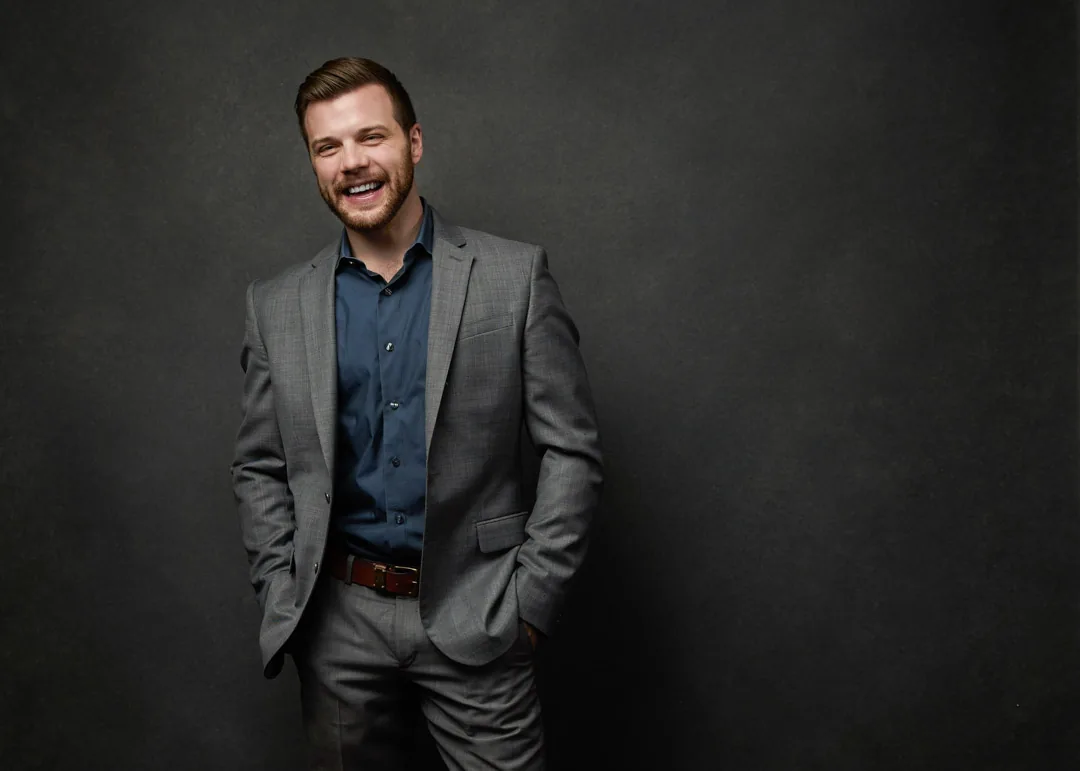
Not sure what to wear for your first casting photo? Here are five things to avoid wearing for actor headshots, and the reason each one hurts you.
What not to wear for actor headshots comes down to five things: loud logos, busy patterns, pure white or dead black, trendy costume pieces, and distracting accessories. Each one steals attention from your face, and in a casting photo your face is the entire product. Get the wardrobe quiet and your eyes and expression do the selling, which is exactly what a casting director is scanning for.
I'm Joshua Albanese, founder and lead photographer at JA Headshots in Fort Myers. Over 18 years I've photographed more than 15,000 professionals, first in Chicago and now here in Southwest Florida, and I've watched a lot of strong actors hand a casting director a photo that works against them because of one wardrobe choice. None of these mistakes are about being stylish or not. They are about what the camera does to certain clothes under studio light. Here are the five to avoid, and the reason each one costs you.
1. Loud logos, slogans, and branded clothing
The first thing to leave at home is anything with a visible logo, brand mark, or printed slogan, because the eye reads text before it reads a face. A casting director flipping through submissions gives each photo a fraction of a second. If there is a word on your chest, that fraction gets spent reading "Nike" or "Vote" or a band name instead of landing on your eyes, and you have lost the only moment you were going to get.
There is a second problem underneath the first. A logo dates the photo and boxes you in. A brand that feels current now looks a few years old by the time you are still submitting the same headshot, and a slogan quietly types you as a certain kind of person before you have read a line. An actor headshot is supposed to be a neutral, castable version of you that a director can imagine in a dozen roles. Branded clothing does the opposite by making a statement you did not choose.
The fix is simple. Wear a solid piece with no visible text or hardware. A plain crew, a clean henley, a simple button-up. Quiet clothing keeps the frame pointed at your face, which is the whole reason you booked the session.
2. Busy patterns and tight stripes
Skip small, repeating patterns and narrow stripes, because they fight the camera in a way you cannot see until it is too late. Tight patterns create a shimmering, vibrating effect on a digital sensor called moire, where the lines of the fabric interfere with the grid of the sensor and produce colored waves that were never in the shirt. It shows up most on thin stripes, small checks, herringbone, and fine houndstooth, which happen to be common in the button-ups people reach for when they want to look put-together.
Even when a pattern does not trigger that effect, it still splits attention. A busy print gives the eye a dozen little places to wander, and every one of them is a place that is not your face. For a casting photo, that is a real cost. The frame has one job, and a loud pattern quietly competes with it the entire time.
Reach for solid colors with, at most, a very subtle texture like a fine knit or a soft heather. Those give the fabric a little life without introducing lines for the sensor to fight. If you love a particular patterned shirt, bring it as a backup, but lead with something solid so we have a clean, safe frame in the bank first.
3. Pure bright white and dead black
Avoid both extremes of the tonal range: pure bright white and pure dead black. They sit at opposite ends of what a camera can hold, and both of them steal light and attention away from your face. Bright white is the brighter thing in the frame, so the eye goes there first and your skin can look dull by comparison. It also reflects studio light back up under your chin, which is rarely flattering.
Dead black has the reverse problem. It crushes into a flat, detail-free shape under studio light, so your shoulders read as a dark void instead of clothing. That void has weight, and it pulls the tonal balance of the whole image downward and away from your eyes. Neither extreme is doing the one thing wardrobe is supposed to do, which is quietly support your face.
Mid-tones are where actor headshots live. A soft blue, a muted green, a warm gray, a deep charcoal instead of true black, a cream instead of stark white. These hold detail, sit comfortably next to your skin tone, and let your face stay the brightest, most detailed thing in the frame. That is the entire trick, and it is why I steer almost everyone toward the middle of the range.
4. Trendy, costume-like, or character-specific pieces
Leave the trendy statement pieces and the costume-adjacent outfits at home, because an actor headshot needs to read as a flexible, castable you, not as one specific character. When you show up dressed as the role you want, you actually narrow how a casting director can picture you. A leather jacket with heavy hardware, a period-looking collar, a very of-the-moment cut. Each one tells the director what to think before they have had a chance to imagine you as anything else.
There is also the dating problem again. Trends move fast, and a headshot is a photo you want to submit for a couple of years. A piece that feels sharp today can look distinctly last-season by the time you are still sending the same file, and that stamps an age on the photo that has nothing to do with you. The most useful headshot is one that could have been taken this year or three years from now.
If you read for a specific type, you can lean toward it gently with tone rather than costume. A grounded, muted look for dramatic reads, something a little warmer and softer for comedic or approachable ones. That is a nudge, not a uniform. Bring a couple of options so we can shoot a range, which is exactly the kind of thing we sort through together at the start of an actor headshot session so your wardrobe is working before we shoot.
5. Distracting accessories and glare-prone glasses
The last thing to avoid is anything that adds visual noise around your face: chunky statement jewelry, a busy scarf, a loud watch, or glasses that throw glare. These sit right in the zone the camera cares about most, the space around your eyes and jaw, so they compete directly with the features that carry the shot. A large earring or a bright necklace becomes a second focal point, and a headshot can only afford one.
Glasses deserve their own note because so many actors wear them. The problem is not the frames, it is reflection. Studio lights bounce off lenses and leave bright hotspots or a milky haze right over your eyes, which is the last place you want anything hiding. If glasses are part of your genuine everyday look, wear them, but bring a pair with anti-glare coating if you have one, and bring the same frames empty or with non-glare lenses as a backup. On the day we can angle the lights and your head to kill most reflections, but starting with the right pair makes that far easier.
The general rule holds across all five points. Anything that adds a second thing for the eye to look at is working against you, because the frame has exactly one job. Keep the clothing and the accessories quiet, and your face gets to be the loudest thing in the room, which is the whole point of a casting photo.
The questions actors ask me most about wardrobe, answered in plain language.
Ready to book an actor headshot that keeps the focus on you?
You do not have to overthink your wardrobe to walk out with a casting-ready photo. Bring a few solid, mid-tone options and we will sort the rest out together in the room. If you're ready to get it done right, reach out through the contact page to book an actor headshot session with JA Headshots in Fort Myers. Sessions are directed start to finish, the session fee is $500, and retouched images are $150 each, so you only pay for the frames you actually want polished. Call (239) 401-6999 if you'd rather talk it through first.
This article was written by Joshua Albanese, founder and lead photographer at JA Headshots in Fort Myers. He founded a top-10 US headshot studio in Chicago, photographed more than 15,000 professionals over 18 years, and relocated to Southwest Florida in 2024. His psychology-driven approach is built for people who are convinced they are not photogenic, including the actors who walk in certain the camera is against them.
Frequently asked questions
What not to wear for actor headshots?
Avoid loud logos and slogans, busy patterns and tight stripes, pure bright white and dead black, trendy or costume-like pieces, and distracting accessories. Every one of these competes with your face for the casting director's attention, and your face is the only thing a headshot is meant to sell. Solid, mid-tone colors in a fit that skims your frame read best, because they stay quiet and let your eyes and expression carry the frame. When in doubt, wear the simplest version of an outfit that still feels like you.
Can actors wear black in headshots?
A soft charcoal or a deep muted tone works, but true dead black usually does not. Pure black crushes into a flat shape under studio light and can lose all the detail in the fabric, so your shoulders read as a black void instead of clothing. That void pulls tonal weight away from your face. If you love a dark look, bring a heathered charcoal or a deep gray so there is still texture and separation. The goal is a garment that supports your face, not one that disappears into the background.
Should actors smile in headshots and does wardrobe change that?
It depends on the roles you read for, and wardrobe should match the tone you are going after. A warmer, approachable look pairs with softer colors and a relaxed neckline, while a grounded dramatic look pairs with a simple structured piece in a muted tone. What stays constant is that the clothing should never announce itself. Whether you smile or not, the wardrobe's job is to stay out of the way so your expression is the loudest thing in the frame.
How many outfits should I bring to an actor headshot session?
Bring three or four solid, mid-tone options on hangers so you can see them under studio light and cover a couple of different looks, like one approachable and one more serious. Different roles call for different tones, and having choices in the room keeps the session relaxed instead of locking you into one shirt you picked at home. At JA Headshots in Fort Myers, we look at your options together at the start so the wardrobe is working for you before we shoot a single frame.
Actor headshot sessions in Fort Myers, directed start to finish and built to keep every eye on your face. $500 session, $150 per retouched image.
Learn more
Written by
Joshua Albanese
Photographer, JA Headshots
Joshua Albanese founded one of the top-10 rated headshot studios in the United States in Chicago in 2007. Over 18 years he photographed more than 15,000 professionals and produced over 3 million images for clients ranging from Fortune 500 executives to first-year associates. In 2024 he relocated to Fort Myers and opened a dedicated portrait studio at 1325 Canterbury Dr. His psychology-driven approach is built for people who say they aren't photogenic.