
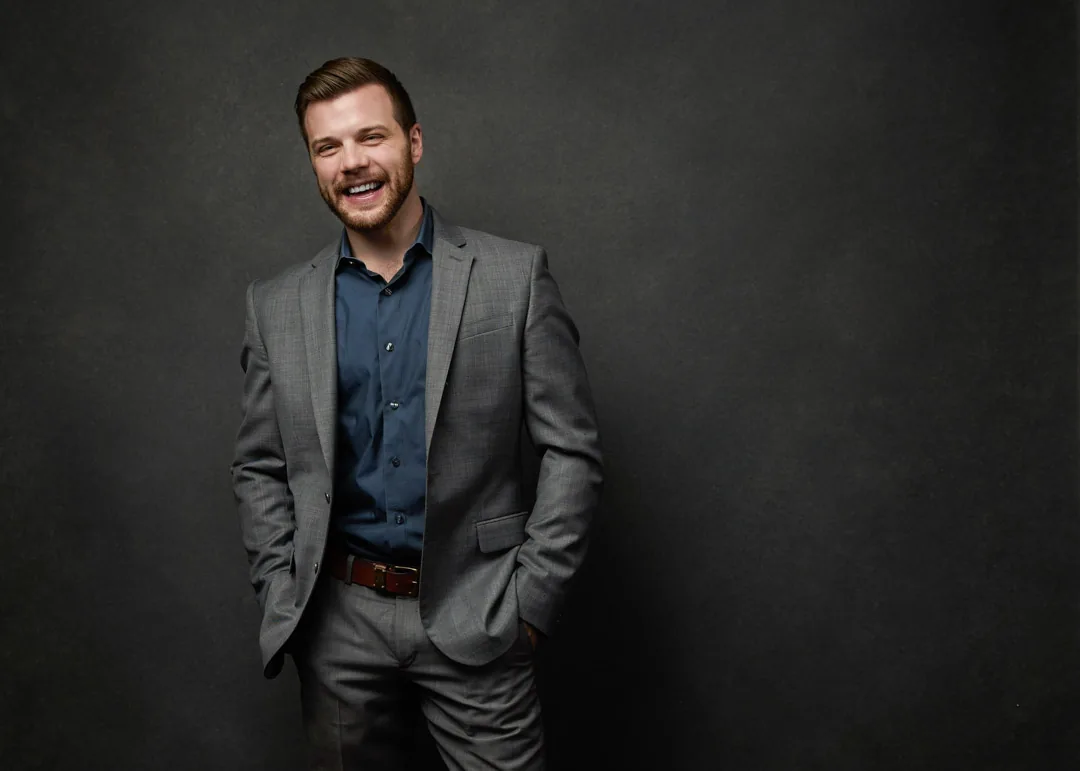
What is a good headshot for actors? It comes down to six things casting notices, plus a few that quietly work against you.
A good headshot for actors is one that looks exactly like you on a real, rested day and lets a casting director feel a connection through your eyes the second they see it. It is not a glamour shot, a phone selfie with a filter, or a moody art portrait. It is an honest, sharp, well-lit read of your face that tells casting who walks through the door and what you can believably play. I shoot every actor headshot session at my studio in Fort Myers, and after photographing more than 15,000 people over 18 years, I can tell you the strong ones almost always share the same six things. Here is what makes an actor headshot work, and what to avoid on each.
I'm Joshua Albanese, and before I relocated to Southwest Florida I built one of the top-10 rated headshot studios in the country up in Chicago. Actors are a specific kind of client, because their headshot is not a nice-to-have. It is the single image that decides whether they get seen at all. So the standard is higher, and the details below matter more than they do for a standard business headshot.
1. It looks exactly like you
The number one job of an actor headshot is accuracy, because you have to match the photo when you walk into the room. Casting directors work from a stack of submissions and pick the faces that fit a role. If the person who shows up looks noticeably different from the picture, you have just burned the one thing casting was counting on, and that memory sticks.
Accuracy is where retouching earns its reputation, good or bad. My rule is that retouching should remove the temporary and keep the permanent. A blemish that will be gone next week, a stray hair, a bit of shine, those come out. The lines that make your face yours, your real jaw, your actual age, those stay. I do not slim faces, erase years, or sculpt someone into a person who does not exist, because the moment you do that the headshot lies, and casting finds out at the audition.
To keep a photo honest, avoid the beauty-filter look, heavy Photoshop, and using an image that is a haircut or two out of date. A headshot from five years ago is not you now. If your look has changed, the photo has to change with it.
2. The eyes connect
Strong actor headshots live and die on the eyes, because that is where a viewer feels a real person looking back. Casting scrolls through submissions fast. The eyes are what stop the scroll. A technically perfect photo with blank, checked-out eyes reads as a stock image, and a stock image does not get called in.
Connection is not an accident, and it is not something you can fake by opening your eyes wider. It comes from an actual thought behind them. When I shoot actors, I direct an inner life, a specific thing to think or a person to imagine on the other side of the lens, so the eyes have somewhere to go. That is the difference between a face that is merely present and a face that is engaged. Sharp focus on the eyes and a clean catchlight do the technical part, but the thought does the human part.
Avoid dead, glassy eyes, squinting into the light, and eyes lost in shadow. Watch out too for looking slightly past the lens, which reads as distracted. The viewer should feel you are looking right at them.
3. The expression matches your type and shows range
A strong actor headshot has a clear, castable read, because casting is trying to place you in a specific kind of role. Your type is the lane you most believably live in, the warm lead, the dry authority figure, the guarded outsider. The expression in the frame should make that lane obvious in a glance, not leave a casting director guessing what you are for.
This is also where range comes in, and why so many actors shoot more than one look. A commercial expression is lighter and more open, the approachable read that sells friendliness. A theatrical expression is more grounded and neutral, the version that can anchor a dramatic scene. Both are subtle. The strongest ones are a real, settled expression that sits just off a smile, not a performance held for the camera.
Avoid the forced, frozen grin, the totally blank neutral that communicates nothing, and the trap of trying to be everything at once. A face that is aiming at all roles lands on none of them. Pick clear reads and let each one be specific.
4. Simple wardrobe and background keep the focus on your face
Everything in an actor headshot that is not your face should get out of the way, because your face is the only thing casting is there to evaluate. Solid, mid-tone colors in a fit that skims your frame photograph best. Necklines that frame the face cleanly, a crew, a simple collar, a plain V, keep the eye moving up to where it belongs. The background stays neutral and soft so nothing behind you competes for attention.
The reason to bring options is that fabrics and colors behave differently under studio light than they do in your closet. I tell actors to bring two or three tops on hangers so we can see what actually reads on the day. Small, quiet choices add up to a frame where you are unmistakably the subject.
Avoid logos, tight patterns, pure white, and dead black, all of which pull the eye off your face. Avoid loud jewelry, and never wear a literal character costume in a headshot. A headshot is you, not a role. Save the costume for the audition or the reel.
5. Natural lighting and true skin
Lighting on an actor headshot should look like flattering daylight and render your skin honestly, because casting needs to read your real coloring. Film and television are lit fairly evenly on faces, so a headshot that matches that world tells casting you will photograph well on set. Soft, even light with a gentle amount of contrast shows the shape of your face without hiding half of it.
There is a reason I do not lean on gimmicks here. Heavy color gels, extreme Hollywood shadow, and trendy lighting effects date fast and, worse, they obscure the exact information a casting director is trying to gather. The light should serve your face, not announce itself. When it is done right, nobody notices the lighting at all. They just see you looking like the best true version of yourself.
Avoid harsh side light that drops half your face into shadow, orange or blue color casts that lie about your skin tone, and blown-out highlights that erase detail. If the lighting is the most interesting thing in the photo, the photo is not working.
6. Correct technical framing and format
A strong actor headshot meets the industry's technical standard, because it has to load cleanly onto the platforms where you get submitted. That means a vertical frame, a crop that runs from roughly the top of your head to your upper chest, and your eyes sitting in the upper third of the image. Your face should be large enough to read at a glance, since casting often views a wall of small thumbnails before clicking anything.
Format is also about deliverables. The final needs to be high resolution, sharp, and retouched to a clean standard so it holds up as a printed 8x10 and as a digital upload. At my Fort Myers studio the session fee is $500, and each retouched final image is $150, so you choose the frames worth finishing and I take those to a platform-ready and print-ready state. That way what you upload is the same quality casting would see in your hand.
Avoid a cropped-down group photo, a low-resolution phone shot, the wrong orientation, and any dated border or name text burned into the image. The photo should look like it was made for this purpose, because it was.
The questions actors ask me most before a session, answered plainly.
Ready to shoot a headshot that gets you seen?
You do not need to be a supermodel to have a headshot casting takes seriously. You need one that looks like you, connects through the eyes, and meets the standard the industry expects. If you are ready to get it done right here in Southwest Florida, book an actor headshot session with JA Headshots in Fort Myers. Sessions are $500 with $150 per retouched image, you are directed the whole way, and most actors walk out with both a commercial and a theatrical look. Call (239) 401-6999 to set it up.
This article was written by Joshua Albanese, founder and lead photographer at JA Headshots in Fort Myers. He founded a top-10 US headshot studio in Chicago, photographed more than 15,000 professionals over 18 years, and relocated to Southwest Florida in 2024. His psychology-driven approach is built for people who are convinced they are not photogenic, including actors staring down their first real headshot.
Frequently asked questions
What is a good headshot for actors?
A good actor headshot is a sharp, honestly lit photo that looks exactly like you on a normal day and connects with the viewer through your eyes. It shows your real type and range, keeps the wardrobe and background simple so nothing competes with your face, and meets the technical format casting platforms expect. The test is simple: if you walked into the audition room, would the casting director recognize you instantly. If yes, the headshot is doing its job.
Do actors need a separate commercial and theatrical headshot?
Many working actors carry both, because the two markets ask for different reads. A commercial look is brighter and more approachable, the friendly neighbor or the enthusiastic customer. A theatrical look is more grounded and neutral, the version that can carry a dramatic scene. You do not have to shoot both to start, but if you audition across both worlds, two clear looks let you submit the right face for each role. In a single session we can capture both without the images blurring into each other.
How much does an actor headshot session cost at JA Headshots?
My session fee is $500, and each retouched final image is $150. The session covers the full shoot with direction the whole way, multiple looks, and time to get expressions that actually read on camera. You then choose which frames to finish, and I retouch those to a clean, print-ready and platform-ready standard. Most actors leave with a commercial and a theatrical option so they are covered for a range of submissions.
Should actor headshots be in color or black and white?
Color is the industry standard for actor headshots, and it is what almost every casting platform expects. Color shows your true skin tone, hair, and eye color, which is exactly the information casting is trying to read. Black and white can look striking, but it strips out details that help a casting director place you, so it is rarely the right primary choice today. Shoot in color first, and treat black and white as an optional extra, not your main image.
Actor headshot sessions in Fort Myers, directed start to finish so your look reads true on every casting platform.
Learn more
Written by
Joshua Albanese
Photographer, JA Headshots
Joshua Albanese founded one of the top-10 rated headshot studios in the United States in Chicago in 2007. Over 18 years he photographed more than 15,000 professionals and produced over 3 million images for clients ranging from Fortune 500 executives to first-year associates. In 2024 he relocated to Fort Myers and opened a dedicated portrait studio at 1325 Canterbury Dr. His psychology-driven approach is built for people who say they aren't photogenic.